Comparison · Official GSC API
SearchOptimo vs IndexProbe: knowing a page dropped, or knowing why
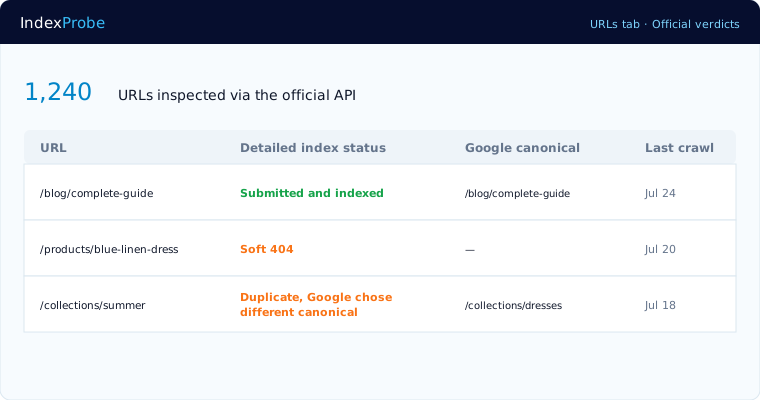
SearchOptimo monitors your URLs by querying Google's results pages, and alerts you when a page stops appearing there — no Search Console access, results in minutes. IndexProbe monitors the same pages from the inside: the official verdict of the URL Inspection API, with the non-indexing reason, the selected canonical and the last crawl. When a page leaves the index, the alert arrives with the cause, not just the observation.
Their product
What SearchOptimo does, described honestly
SearchOptimo is a deindexing-alert tool: you load a list (CSV, sitemap, up to 20,000 URLs per scan), it checks who appears in Google, then “campaigns” re-check your critical pages daily or every six hours, with an email, Slack or webhook alert the moment a status flips. Free tier of 100 URLs with no card, submission to Bing and other engines. The method is claimed without detour: they query Google's live index directly, never touching your Search Console — “0 GSC permissions”.
Their argument deserves recognition, because it is sharper than most checkers': they write themselves that Search Console is irreplaceable — “first-party Google data no third party can reproduce” — and point at three real limits of its reports: aggregate, delayed by days, no per-URL alert. On those three precise points, they are right: the Page indexing report is not an alarm.
But a report is not an API. The same Search Console exposes the URL Inspection API: each URL's official record, queryable in real time, reason included. That is the path IndexProbe chose — it requires being authorized on the property, and that requirement unlocks exactly what scraping can never read: Google's decision, and its why.
The split
Where the two models diverge: the observation, or the cause
Two gaps decide the choice. First: their status is the SERP's word — yet Google documents that those queries “don't necessarily return all the URLs that are indexed”; a page can vanish from the scrape while remaining indexed, and the alert fires anyway. Second, deeper: their alert says a page fell; it never says why.
Their own explainer page shows it despite itself: it lists five possible causes of deindexing — an accidental noindex, a robots.txt block, a mispointed canonical, server errors, a quality signal — then stops there. The tool observes the fall; the investigation to sort those five leads out starts after the alert, by hand, in the Search Console the tool has sworn off touching.
At IndexProbe, the regression arrives named: “Soft 404”, “Duplicate, Google chose different canonical”, “Excluded by noindex tag”. And it arrives fast: suspected regressions — pages with clicks but no recent impression — are inspected first in every analysis, so the verdict that changes your week lands within hours, cause included.
The value
What you get for your money
At every price point, the IndexProbe subscription buys the alert with its cause, scale with its recurrence, and an analysis layer a scraped status cannot carry.
The alert with the cause
For every page that left the index: the exact official status, the reason, the canonical Google selected, Googlebot's last visit. Two “vanished” pages can call for two opposite fixes; the alert that names the cause saves the entire investigation.
Scale and recurrence, included
60,000 URLs per analysis from Pro, 100,000 on Agency, and recurring analyses cover the whole list, with no monthly cap: re-checking consumes nothing. SearchOptimo's Elite plan stops at 20,000 URLs a month.
An analysis layer above the alerts
The declared canonical against the one Google selected, with a difference badge. Segmentation by AI or regex, statuses crossed by segment and by date, the Comparison view between two analyses, the domain-aggregated view. And crawl read from Google's own data: 30-day rate, frequency, HTTP codes as seen by Googlebot.
Where SearchOptimo stands out
Zero property access: they can audit sites you don't manage — the pre-sales audit of a prospect, third-party URLs — ground closed to us by design. Their six-hour re-check cadence is real on a small list: for the raw latency of spotting a SERP absence, it is fast — detecting without the reason doesn't shorten the fix, but the point is theirs. An honest free tier (100 URLs, no card), and a multi-engine submission that isn't our trade.
Side by side
Line by line
The same comparison, laid out. Their column reflects their published capabilities, read on 2026-08-31.
| SearchOptimo (published capabilities, read 2026-08-31) | IndexProbe | |
|---|---|---|
| Method | Direct SERP querying, claimed (“0 GSC permissions”) | Official URL Inspection API, on your properties |
| What an alert says | “This page disappeared from the index” | “This page left the index because…” — official reason included |
| Status reliability | SERP presence — a method Google documents as non-exhaustive | Google's decision itself |
| Regression detection | Scheduled re-check, “AT RISK” status | Suspected regressions inspected first in every analysis |
| Monitored volume | Elite: 20,000 URLs per month | Up to 100,000 URLs per analysis, recurrence with no monthly cap |
| Cadence | Daily or 6-hourly on campaigns | Recurring analyses over the whole list, regressions first |
| Speed levers | — | Accelerated mode (impressions without quota), multi-property, automatic resume |
| Top capacity | 20,000 per scan maximum | 60,000 inspections/day on Agency — up to 1.8M distinct URLs a month |
| Canonical | Cited as a possible cause, not read | Declared vs Google-selected, difference badge |
| Segmentation & charts | Campaign counters, flip history | AI or regex, statuses by segment and date, pies, Comparison view |
| Third-party URLs (prospects, backlinks) | Yes — no property access needed | No: authorized properties only |
| Submission | Bing and 8+ engines | Out of scope, by design |
| Free / trial | 100 URLs/month, no card | 10 days, no credit card |
Pricing
SearchOptimo pricing vs IndexProbe pricing
SearchOptimo prices by monthly check volume: Basic $0 (100 URLs/month), Growth $14.99 (1,000), Scale $29.99 (3,000, API), Elite $99.99 (20,000, unlimited campaigns) — read from their page on August 31, 2026, −20% annual, 30-day guarantee. IndexProbe prices by projects: $49, $99 or from $109 a month, official verdicts and recurrence included.
The deal, spelled out: at the same round price — 99 — their Elite caps at 20,000 SERP statuses per month; our Agency opens 60,000 official inspections per day, up to 1.8 million distinct URLs a month, reasons included. And at the entry: their Growth at $14.99 checks 1,000 URLs a month; our Pro at $49 analyzes 60,000 URLs per analysis, recurrence included — with, for every non-indexed page, the official cause that scraping cannot provide.
SearchOptimo plans
As published on August 31, 2026 — check their page for current rates: Basic $0, 100 URLs/month, 3 campaigns · Growth $14.99/month, 1,000 URLs, 30-day history · Scale $29.99, 3,000 URLs, custom frequencies, API · Elite $99.99, 20,000 URLs, unlimited campaigns, 365-day history. Annual −20%, 30-day guarantee.
IndexProbe plans
Pro $49/month, 10 projects, 60,000 URLs per analysis, AI segmentation · Agency $99/month, 3 Search Console accounts, 30 projects, 100,000 URLs per analysis · Custom from $109/month, Agency plus extensions (+10 projects, +1 account). Recurring analyses and alerts on every plan. Free 10-day trial, no credit card.
Honest framing
What IndexProbe does, and does not do
IndexProbe reads the official verdicts of the Search Console API on the properties you are authorized on. The honest comparison covers what surrounds that data — and what stays outside our scope.
100% official data
The same verdicts as Search Console's URL inspector, non-indexation reason included, with no scraping and no estimates.
Your lists, not a crawl
Search Console export, CSV, sitemap, or paste, up to 100,000 URLs per analysis. IndexProbe does not discover URLs by following links.
One quota per property, levers to multiply it
The URL Inspection API allows 2,000 URLs per day per property, but IndexProbe gets you past that limitation. Three mechanisms add up. The accelerated inspection mode first: pages that received recent impressions, or whose indexing was recently confirmed, are counted through an API with a separate quota — without touching the inspection one. Multi-property aggregation next: the ceiling applies to the property, not the site; with 10 prefix properties created in your Search Console, at least 20,000 URLs are processed every day, more than 140,000 distinct URLs in a week — and the accelerated mode often does better. Plan scale last: the Agency plan's 30 projects open up to 60,000 inspections a day, potentially 1.8 million distinct URLs in a month before the accelerated mode even counts. A day's overflow slides into the next one on its own.
What stays out, owned
No third-party URL checking: the Search Console authorization we require is what unlocks the official data. No multi-engine submission. For a pre-sales audit without client access, SearchOptimo's formula works — and the day access exists, the official verdict takes over.
FAQ
Frequently asked questions
Do SearchOptimo and IndexProbe use the same data?
No. SearchOptimo queries Google's results pages directly, without Search Console access — their site claims it openly. IndexProbe reads the official URL Inspection API on properties you are authorized on: status, non-indexing reason, canonical, crawl information. One reports an observed presence, the other Google's decision.
Isn't their alert faster than recurring analyses?
On the raw latency of spotting a SERP absence for a small list, their six-hour cadence is real. Two nuances weigh in: an absence from scraped results is not a confirmed deindexation — the method produces false alarms that only an official inspection settles — and the alert arrives without the cause, so the investigation remains whole. At IndexProbe, suspected regressions are inspected first in every analysis: the verdict lands within hours, reason included.
Is a page missing from search results necessarily deindexed?
No. Google documents that those queries don't necessarily return all indexed URLs, especially on large sites. A page can miss the roll call one day and reappear the next without ever leaving the index. The only definitive answer is the URL Inspection tool's — the one whose API IndexProbe reads, in bulk.
How does IndexProbe detect an indexing regression?
By crossing signals: a page that used to receive clicks but records no recent impression is suspected of having left the index. Those pages move to the front of the inspection queue in every recurring analysis, and the email alert goes out with the official status and its reason as soon as the exit is confirmed.
Can I monitor URLs I don't manage?
Not with IndexProbe: the official API requires authorization on the property. To audit a prospect's site before signing, or to check third-party placements, a tool without property access like SearchOptimo fits — the two approaches complement each other, each on its own ground.
How do prices compare at scale?
SearchOptimo: from $0 to $99.99 a month, capped at 20,000 monthly SERP checks at the top. IndexProbe: $49, $99 or from $109 a month — and the Agency plan allows up to 60,000 official inspections a day, potentially 1.8 million distinct URLs a month, each with Google's verdict and reason. 10-day trial, no card.
The alert that arrives with the cause
Connect your Search Console, import your list. When a page leaves the index, you'll know which one, when — and why. From $49/month, 10 days free, no card.
Start the free 10-day trial