Comparison · Official GSC API
IndexCheckr vs IndexProbe: monitoring paid by the credit, or the reason behind every missing page
IndexCheckr checks in bulk whether your pages and links show up in Google, schedules re-checks, and offers to resubmit the missing ones in one click. IndexProbe queries the official Search Console API and reports what Google decided about each page: the status, the non-indexing reason, the selected canonical, Googlebot's last visit. A difference in kind, and a difference on the invoice: there every re-check consumes a credit, here recurrence is part of the subscription.
Their product
What IndexCheckr does, described honestly
Let us say it up front: it is the most accomplished product in its category. Bulk checking by paste, CSV or XML sitemap, with two controls per URL for accuracy. Scheduled recurring checks and email notifications. Time-stamped history showing how long a page took to enter the index. Full CSV export, a usage report, unlimited team seats sharing the credits, a REST API, a Chrome extension to check a page while browsing, and a free noindex tag checker. All of it in four languages, with no subscription, paid by the credit consumed.
Their workflow is coherent end to end: a page comes back not indexed, and the tool offers to resubmit it in one click to an indexing service, from seven available integrations. For anyone buying links or publishing at volume, that sequence makes sense, and it is well executed.
Two points deserve stating, because they decide the choice. First, what a check returns stays binary: the page shows up, or it doesn't, with no indication of why Google set it aside. Second, monitoring is paid at every pass. That is not our inference: their own usage report breaks down credit consumption by re-check frequency, daily or weekly. That feature exists because monitoring, there, consumes.
The split
Where the two models diverge: resubmit, or fix the cause
When a page is missing, IndexCheckr offers to send it back to an indexer. IndexProbe tells you why Google did not keep it. Same starting observation, very different follow-ups, because resubmitting a page Google set aside does not change Google's decision; fixing the reason does.
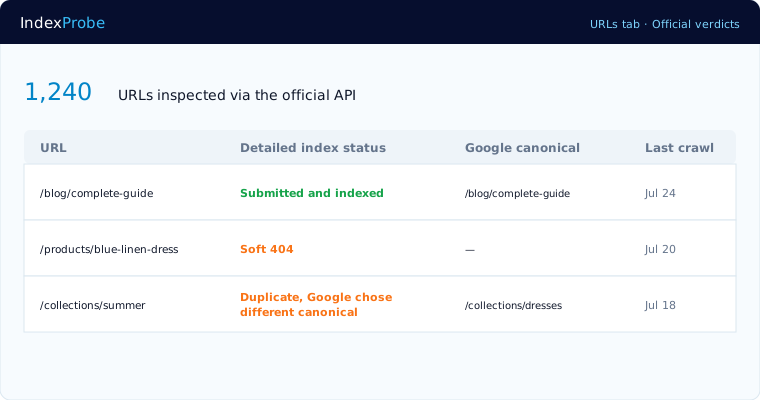
The reason is not a comfort feature: it names the fix. A page in Soft 404 needs content, not a submission. A page whose canonical Google reassigned needs consolidation. A page carrying a noindex tag inherited from a release needs a deployment fix. Those are three different jobs, and a binary status leaves all three indistinguishable.
The second gap is economic, and it widens with frequency. Checking a list once costs little at IndexCheckr, which is one of their strengths. Monitoring 30,000 URLs every week represents about 130,000 checks a month, between $195 and $325 depending on the credit tier reached, for answers that stay binary. At IndexProbe, the same monitoring is included in a $19 subscription, reasons included, whatever the frequency you choose.
The value
What you get for your money
At every price point, the IndexProbe subscription buys the reason behind the observation, repetition without a meter, and an analysis layer a status table cannot carry.
The reason, and what it saves
For every URL: the exact official status among the Search Console statuses, the reason when the page isn't indexed, the canonical Google actually selected against the one you declare, the date of Googlebot's last visit. The investigation that follows a binary alert, you don't run it: it is already done.
Monitor without the meter running
Recurring analyses across the whole list, email alerts when a page leaves the index, the Comparison view between two analyses, a history of 5 to 30 analyses per project depending on the plan. Going back over 30,000 or 100,000 URLs costs nothing extra, and suspected regressions are inspected first, so the verdict that matters lands within hours.
An analysis layer above the checks
Segmentation generated by AI or hand-written, with editable regex. Status, noindex, robots.txt and canonical pies; statuses crossed by segment and by inspection date. A Referring URLs column for internal linking. 30-day crawl rate, average frequency and HTTP codes as seen by Googlebot, without touching log files. And the domain-aggregated view, consolidated and deduplicated, for sites spread across several properties.
Where IndexCheckr stands out
The list is long, and it is real. They check URLs you don't manage, backlinks and third-party pages included, which the official API forbids us by design. They resubmit in one click to seven indexing services, a trade that is not ours. They offer a public REST API, a Chrome extension to check a page while browsing, and a free noindex tag checker: three things IndexProbe does not offer today. Their team seats are unlimited and share the credits, where ours follow the plans. And their time-stamped history shows the delay before a page enters the index, a metric we do not present in that form.
Side by side
Line by line
The same comparison, laid out. Their column reflects their published capabilities, read on 2026-09-25.
| IndexCheckr (published capabilities, read 2026-09-25) | IndexProbe | |
|---|---|---|
| Source | Presence check in Google, two controls per URL | Official URL Inspection API, on your properties |
| What a result says | Indexed, or not indexed | Official status, non-indexing reason, selected canonical, last crawl |
| When a page is missing | One-click resubmission to a third-party indexer | The reason, so the fix to apply |
| Monitoring | Recurring, with email notifications | Recurring, with email alerts and regressions inspected first |
| Cost of repeating | 1 credit per URL per pass | Included in the subscription, no meter |
| Monitoring 30,000 URLs weekly | ≈ 130,000 credits/month, $195 to $325 | Starter $19/month, reasons included |
| Canonical | — | Declared vs Google-selected, difference badge |
| Segmentation & charts | CSV export, usage report | AI or regex, statuses by segment and date, pies, Comparison view |
| Crawl | — | 30-day rate, frequency, HTTP codes seen by Googlebot, no logs |
| Multi-property | — | Domain-aggregated view, consolidated and deduplicated |
| Top capacity | Unlimited, on the meter | 60,000 inspections/day on Agency, up to 1.8M distinct URLs a month |
| Third-party URLs (backlinks, prospects) | Yes, no property access | No: authorized properties only |
| Resubmission | Seven indexer integrations | Out of scope, by design |
| Public API and Chrome extension | Both | Neither (CSV export) |
| Getting started | 50 free credits | 10-day trial, no credit card |
Pricing
IndexCheckr pricing vs IndexProbe pricing
IndexCheckr sells credit packs with no subscription, from smallest to largest: $15 for 2,000 credits, $40 for 10,000, $125 for 50,000, $300 for 200,000, $700 for 500,000 and $1,300 for a million, from $0.0075 down to $0.0013 per check (read from their page on September 25, 2026 — check it for current rates). IndexProbe sells subscriptions: $19, $49 or $99 a month, official verdicts and recurrence included.
The deal, spelled out: for a one-off check, their model is economical and we are not disputing it. The ratio changes as soon as monitoring becomes regular. Following 30,000 URLs every week represents about 130,000 credits a month, $195 to $325 depending on the tier, for binary answers. IndexProbe's Starter at $19 covers 3 projects and 30,000 URLs per analysis, with recurring analyses, alerts and the reason for every non-indexed page. One tier up, Agency at $99 opens up to 60,000 official inspections a day, potentially 1.8 million distinct URLs a month, aggregated by domain.
IndexCheckr pricing
No subscription, 1 credit equals 1 check: tiny $15 / 2,000 credits · small $40 / 10,000 · medium $125 / 50,000 · large $300 / 200,000 · xl $700 / 500,000 · xxl $1,300 / 1,000,000. From $0.0075 down to $0.0013 per unit. 50 credits free at signup, unlimited team seats sharing the account's credits.
IndexProbe plans
Starter $19/month, 3 projects, 30,000 URLs per analysis · Pro $49/month, 10 projects, 60,000 URLs, AI segmentation · Agency $99/month, 3 Search Console accounts, 30 projects, 100,000 URLs per analysis, add-ons (+10 projects, +1 account). Recurring analyses and alerts on every plan. Free 10-day trial, no credit card.
Honest framing
What IndexProbe does, and does not do
IndexProbe reads the official verdicts of the Search Console API on the properties you are authorized on. The honest comparison covers what surrounds that data, and what stays outside our scope.
100% official data
The same verdicts as Search Console's URL inspector, non-indexation reason included, with no scraping and no estimates.
Your lists, not a crawl
Search Console export, CSV, sitemap, or paste, up to 100,000 URLs per analysis. IndexProbe does not discover URLs by following links.
The daily quota, and the three levers that widen it
The official inspection API grants 2,000 URLs per day per property, but IndexProbe gets you past that limitation. First lever, a second API whose quota is independent: the accelerated inspection mode counts there the pages that received recent impressions, or whose indexing was recently confirmed, without drawing a single unit from the inspection quota. Second lever, the granularity of the ceiling, which applies to the property and not to the site: create 10 prefix properties in your Search Console, and at least 20,000 URLs are processed every day, more than 140,000 distinct URLs over a week, and more still once the accelerated mode kicks in. Third lever, the plan itself: at Agency-plan scale, 30 projects × 2,000 URLs per day open up to 60,000 daily inspections, potentially 1.8 million distinct URLs in a month, before the accelerated mode even counts. Whatever exceeds a day rolls over to the following ones on its own.
What we don't do, and they do well
No third-party URL checking, no resubmission to indexers, no public API and no browser extension. Those uses exist, IndexCheckr covers them, and many consultants will gain from running both tools side by side: theirs for links acquired outside, ours for the properties they are responsible for.
FAQ
Frequently asked questions
Do IndexCheckr and IndexProbe use the same data?
No. IndexCheckr checks whether your pages show up in Google and applies two controls per URL to make the result more reliable, without requiring access to your Search Console. IndexProbe reads the official URL Inspection API on the properties you are authorized on, and reports the status, the non-indexing reason, the canonical Google selected and crawl information. One observes a presence, the other restates a decision.
Is resubmitting a non-indexed page enough to get it indexed?
Not if the cause remains in place. A page set aside for thin content, a canonical pointing elsewhere or a forgotten noindex tag will be set aside again after resubmission, because the reason Google excluded it has not changed. That is why IndexProbe shows the official reason rather than offering a resend: it names the fix to apply before asking Google again.
How do the costs of regular monitoring compare?
At IndexCheckr, every re-check consumes a credit, and their usage report actually breaks down consumption by frequency. Following 30,000 URLs every week comes to about 130,000 credits a month, between 195 and 325 dollars depending on the tier reached. At IndexProbe, recurring analyses are included in the subscription, from 19 dollars a month, whatever the frequency.
For checking backlinks, which tool should I choose?
IndexCheckr. Checking links acquired on third-party sites requires no access to the properties involved, and that is precisely what they do well, with resubmission to indexing services on top. IndexProbe does not cover that use, since the official API requires Search Console authorization on the inspected domain.
What does IndexProbe show that a binary status doesn't?
The exact reason when a page isn't indexed, the canonical Google actually selected against the one you declare, the date of Googlebot's last visit, the 30-day crawl rate, and statuses crossed by segment and by date. Two non-indexed pages can call for two opposite fixes, and it is the reason that tells them apart.
Does IndexProbe offer an API or a Chrome extension?
Not today, and that is a real advantage for IndexCheckr, which offers both. At IndexProbe, CSV export covers integration into your reports, and recurring analyses automate the follow-up without writing any code or installing anything.
The reason, before the resubmission
Connect your Search Console, import your list. Status, reason, canonical, last crawl, and the same analysis repeated with no meter. From $19/month, 10 days free, no card.
Start the free 10-day trial