Comparison · Official GSC API
Rapid Index Checker vs IndexProbe: two tools for two different questions
Rapid Index Checker asks Google's results pages whether a URL is visible right now. IndexProbe asks Google's own API what it decided about your pages: indexed or not, why, which canonical, when it last crawled. Two different questions — and for many teams, two complementary tools.
The real question
What “is it indexed?” actually means
A page can be visible in a site: query today and gone tomorrow, with no explanation either way. Visibility checks answer “can I see it right now?”. The decision layer answers “what did Google decide, and why?”. Diagnosing and fixing indexing requires the second question.
Google's own documentation qualifies SERP-based checking: the site: operator “doesn't necessarily return all the URLs that are indexed”, the list “is not always exhaustive”, and “bigger sites shouldn't expect to see all their URLs in the results”. For a definitive answer, that same page points to one place: the URL Inspection tool — the API IndexProbe is built on.
SERP checking is what it is: fast, no property access needed, works on any URL — and silent about the one thing that drives the fix: the reason. A URL absent from the results could be “Crawled - currently not indexed”, a Soft 404, canonicalized to another page, or simply not returned by the query.
The clarification
One company, two products: Rapid URL Indexer and Rapid Index Checker
Both tools are published by the same company, GrowMatic. Rapid URL Indexer submits URLs for indexing, on credits, with refunds for URLs that don't make it. Rapid Index Checker verifies visibility through live SERP queries. Submission and visibility — neither reads Google's official decision about your pages.
The two names get mixed up constantly, so here is the split: the Indexer pushes URLs toward Google's crawl; the Checker then samples Google's results to see what is visible. Both operate from the outside, without access to your Search Console property.
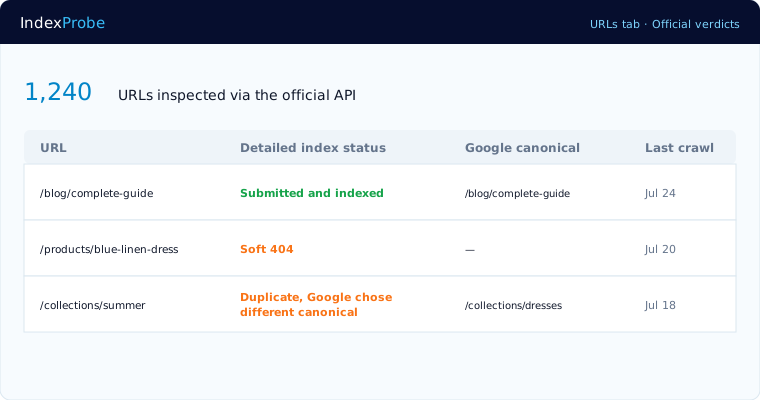
IndexProbe answers the third question, from the inside: for every page of a property you manage, the official verdict of the URL Inspection API — status, non-indexing reason, the canonical Google selected, the date of Googlebot's last visit — in bulk, with history.
The fit
What each tool is built for
Choose by the question you are asking. Visibility of URLs you don't control: a SERP checker. The official status of pages you do control, with the reason and the fix: the inspection layer. Many agencies run both.
Where Rapid Index Checker is the right tool
Checking URLs you don't manage: backlinks, guest posts, third-party placements — no property access exists there, and SERP checking is the only option. It is fast (200 URLs per second, a 100,000-URL job in about 8 minutes, as announced at launch), has a free tier, and flags on-page blockers like noindex tags or robots.txt rules. That job sits outside IndexProbe's scope by design — the property authorization we require is exactly what unlocks the official data they can't read.
Where IndexProbe is the right tool
Your sites and your clients' sites. Each URL gets Google's official record: exact status among the Search Console statuses, the reason it isn't indexed, the canonical Google actually selected, the last crawl date. Segments by page type, regression detection, the Comparison view between analyses, email alerts.
The reason changes the fix
A binary “not visible” starts a guessing game. The official reason ends it: “Crawled - currently not indexed” is a quality or priority problem; Soft 404 is a content problem; “Duplicate, Google chose different canonical” is a consolidation problem; a noindex tag is a release problem. Resubmitting a page Google rejected doesn't change Google's decision — fixing the reason does.
Using both together
A legitimate stack: Rapid Index Checker for visibility on third-party URLs, IndexProbe for the decision layer on the properties you manage. The overlap is small; the questions are different.
Side by side
Same job, different league
In one day, Rapid Index Checker returns a visibility snapshot — one-shot. In one day, IndexProbe returns up to 60,000 official verdicts (Agency plan, 30 properties) and starts again the next day, without limit: up to 1.8 million distinct URLs a month for $99, reasons included — a third of the price of a 100,000-check snapshot.
| Rapid Index Checker | IndexProbe | |
|---|---|---|
| Data source | Live Google SERP queries | Official URL Inspection API of your property |
| What you learn per URL | Visible right now: yes / no | Official status, the non-indexing reason, the canonical Google selected, last crawl date |
| In one day | A visibility snapshot — one-shot | Up to 60,000 official verdicts (Agency, 30 properties) — and the analysis restarts every day, without limit |
| 100,000 URLs — what you get | A yes/no per URL | The full official record, segment by segment (indexed rate per segment, the reason for every non-indexed URL, declared vs Google-selected canonicals, last crawl dates, 30-day crawl rate) |
| 100,000 URLs — time | ≈ 8 minutes (as announced at launch) | Google's API allows 2,000 inspections/day per property — IndexProbe blows past that limit: 2 days with 30 prefix properties (60,000/day), about 5 days with 10, and faster still with the accelerated mode, which skips URLs with impressions or already confirmed indexed |
| Monthly capacity | 100,000 checks/month on the top plan | Up to 1.8 million distinct URLs a month (30 projects × 2,000/day × 30 days) — before the accelerated mode |
| Price at the 100,000-URL scale | Business, $279/month | Agency, $99/month |
| Canonical intelligence | Canonical tag conflicts, checked on-page | The canonical Google actually selected, vs declared, with a difference badge |
| Segmentation & charts | Not documented | AI or regex segmentation; status, noindex, robots.txt and canonical pies; statuses by segment and date |
| Internal linking & crawl | — | Referring URLs column; 30-day crawl rate, crawl frequency and Googlebot HTTP codes, without logs |
| Re-checking / monitoring | Metered per check: re-checks draw on the monthly volume | Recurring analyses included, email alerts, suspected regressions inspected first |
| History & comparison | 30 days (Free) to 3 years (Business) | 5–30 retained analyses per project, side-by-side Comparison view |
| Getting started | Free plan, 150 checks/month | Free 10-day trial, no credit card |
Pricing
Rapid Index Checker pricing vs IndexProbe pricing
Rapid Index Checker's top plan is $279/month for 100,000 yes/no checks. IndexProbe's Agency plan is $99/month for up to 1.8 million distinct URL inspections a month — 30 projects × 2,000 per day × 30 days, before the accelerated mode — with the reason for every non-indexed page included.
The deal, spelled out: for 100,000 URLs, you trade an 8-minute snapshot for the official record in 2 days (30 prefix properties) or about 5 days (10 properties) — at roughly a third of the price, with the why included, and the analysis starts again every day instead of stopping at one shot. Add-ons if needed: +10 projects or +1 Search Console account.
Rapid Index Checker plans
As published at launch, March 2026 — check their pricing page for current rates: Free 150 checks/month, 1 project, 30-day history · Lite $12/month, 3,000 checks, 10 projects · Pro $39/month, 12,000 checks, 50 projects, API · Team $119/month, 40,000 checks, 5 seats · Business $279/month, 100,000 checks · Credit packs $29 / 5,000, $59 / 12,000, $149 / 30,000.
IndexProbe plans
Pro $49/month, 10 projects, 60,000 URLs per analysis, AI segmentation · Agency $99/month, 3 Search Console accounts, 30 projects, 100,000 URLs per analysis · Custom from $109/month, Agency plus the extensions you need for more accounts or projects. Every plan reads the official API — status, reason, canonical, crawl — and starts with a free 10-day trial, no credit card.
Honest framing
What IndexProbe does, and does not do
IndexProbe reads the official verdicts of the Search Console API on the properties you are authorized on. It does not scrape results pages, and it does not check URLs you don't manage: that's the other tool's job, and we're fine with that.
100% official data
The same verdicts as Search Console's URL inspector, non-indexation reason included, with no scraping and no estimates.
Your lists, not a crawl
Search Console export, CSV, sitemap, or paste, up to 100,000 URLs per analysis. IndexProbe does not discover URLs by following links.
Google's quota, handled for you
Official inspection is capped at 2,000 URLs per day per property, but IndexProbe gets you past that limit. First through the accelerated inspection mode: pages with recent impressions or whose indexing was recently confirmed are counted without consuming that quota, through an API with a separate quota. Then through multi-property aggregation: the quota applies per property, and IndexProbe aggregates the projects of a single domain — with 10 prefix properties created in your Search Console, at least 20,000 URLs are processed every day — more than 140,000 distinct URLs in a week — and often far more thanks to the accelerated mode. At Agency-plan scale, 30 projects × 2,000 URLs per day open up to 60,000 daily inspections — potentially 1.8 million distinct URLs a month, before the accelerated mode even kicks in. Whatever remains spreads automatically over the following days.
Two tools for two questions
For backlinks and third-party placements, a SERP checker like Rapid Index Checker is the right instrument, and we say so. IndexProbe requires the property owner's authorization — that requirement is exactly what unlocks the official data.
FAQ
Frequently asked questions
What is the difference between Rapid Index Checker and Rapid URL Indexer?
They are two products from the same company, GrowMatic. Rapid URL Indexer submits URLs for indexing, on a credit system with refunds for URLs that don't get indexed. Rapid Index Checker verifies whether URLs are visible in Google through live SERP queries. Neither reads the official verdict of the URL Inspection API.
Is a site: check a reliable way to verify indexing?
Google's own documentation says the site: operator doesn't necessarily return all indexed URLs, that the list is not always exhaustive, and that bigger sites shouldn't expect to see all their URLs. For a definitive answer, Google points to the URL Inspection tool — the API IndexProbe automates at scale.
Can IndexProbe check backlinks or third-party URLs?
No, by design. The official API requires being authorized on the Search Console property, so IndexProbe covers sites you own, manage, or work on with delegated access. For visibility checks on URLs you don't control, a SERP-based checker is the right tool.
How do the prices compare?
Rapid Index Checker prices by check volume: $12 to $279 per month plus credit packs, as published at launch. IndexProbe prices by projects and analysis capacity: $49, $99 or from $109 per month — and the Agency plan's 30 projects allow up to 60,000 inspections a day, potentially 1.8 million distinct URLs a month, official data included, with a free 10-day trial and no credit card.
Can I use both tools together?
Yes, and some agencies do: a SERP checker for the visibility of backlinks and third-party placements, IndexProbe for the official status, reason and canonical of the pages on properties they manage. The two barely overlap.
A page disappeared from my site: searches. What should I do?
Follow Google's own advice: inspect the URL. IndexProbe does it in bulk — official status, the reason, the canonical Google selected, the last crawl date — and its recurring analyses inspect suspected regressions first, so the verdict arrives within hours.
The official verdict, at scale
Connect your Search Console, import your URLs. Status, reason, canonical, last crawl: from Google's own API, page by page.
Start the free 10-day trial