Google index checker
The bulk Google index checker built on official Search Console data
Check the index status of every URL on your site: the verdict, the reason it's out, the canonical Google chose, the last crawl date, and the rest of the official record. Straight from the URL Inspection API, not scraped from search results.
Why most checkers get it wrong
A site: search is not Google's index
Most index checkers, free and paid alike, work the same way: they query Google with site: searches and read the results page. What comes back is a binary guess, indexed or not, with no official reason, no canonical, no crawl date.
SERP-scraping checkers (free & paid)
A guess read off the results page
An indexed / not-indexed verdict, sometimes with diagnostics from the tool's own crawl. What they can never show you: Google's stated reason, the canonical Google selected, or the last crawl date.
IndexProbe
The official verdict, per URL
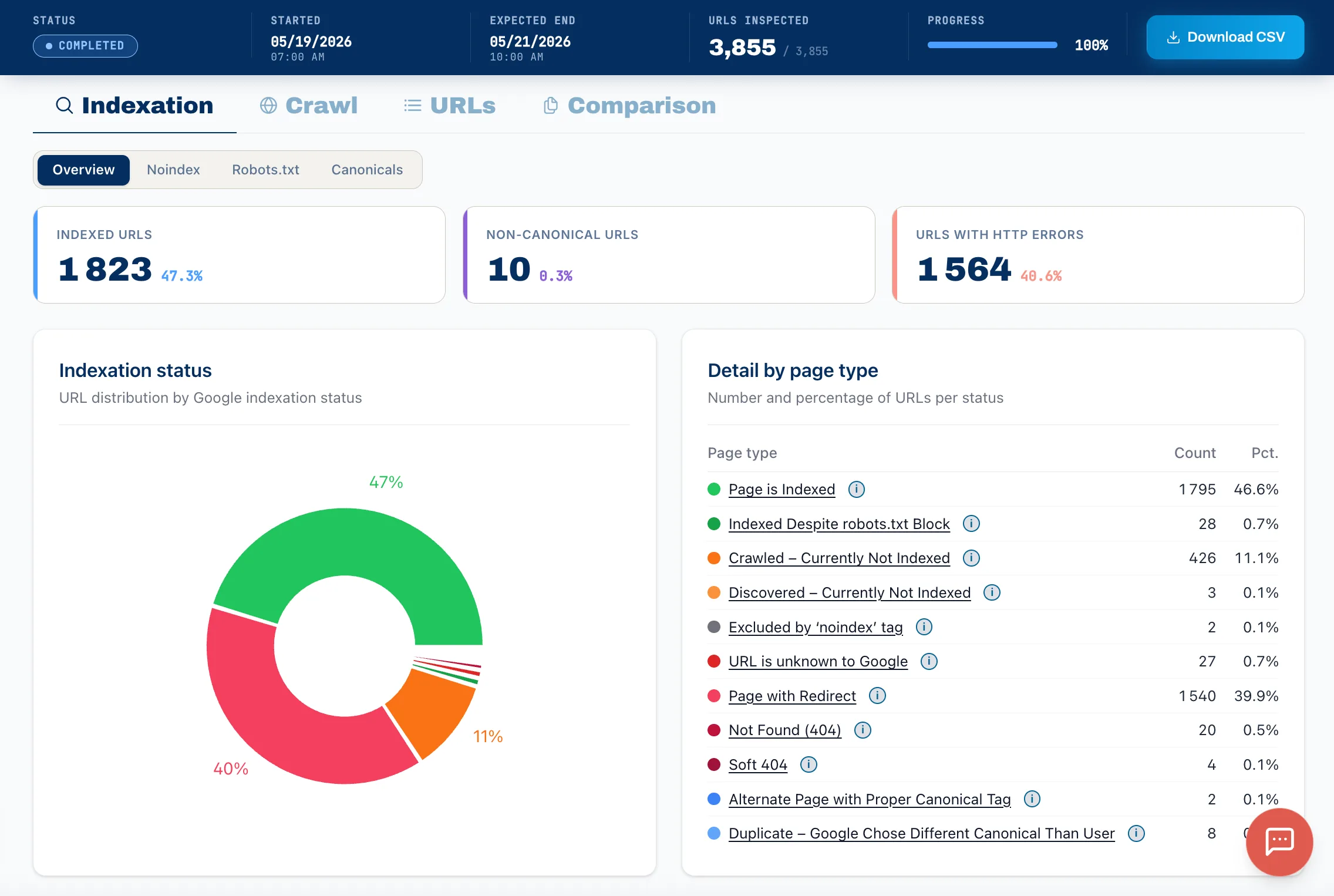
The same data Search Console shows: “URL is on Google” or the exact coverage state (“Crawled - currently not indexed”, “Excluded by 'noindex' tag”…), the canonical Google selected, and the last crawl date.
How it works
Your list in, official verdicts out
Bring your URLs
Paste a list, upload a CSV, point to your sitemap, or import straight from your Search Console: by clicks, impressions, or URL pattern (regex).
We run the official inspections
Every URL goes through Google's URL Inspection API at quota pace. Pages already proven indexed are carried over, not re-inspected, so the quota goes where it teaches you something.
Read, segment, export
One row per URL: verdict, coverage state, canonical, last crawl. Filter by status, segment by page type, compare analyses over time, export to CSV.
What you get
The full official status record, not just a verdict
IndexProbe surfaces every field of the URL Inspection API's status record, for every URL in your list. The highlights:
Verdict
“URL is on Google”, or not: Google's overall call (indexed, excluded, error) for each URL.
Coverage state
The official reason, in Google's own words: “Crawled - currently not indexed”, “Soft 404”, “Page with redirect”…
Noindex detection
Whether indexing is allowed, and if not, where the noindex lives: meta tag or HTTP header. A distinction few tools surface.
Robots.txt state
Whether robots.txt allowed or blocked the crawl of each URL.
Googlebot's fetch result
What the server answered when Googlebot came: success, 404, 5xx, redirect, soft 404, access denied…
Crawl dates
The last successful crawl, the user agent used (mobile or desktop), the inspection date, and whether the page was crawled in the last 30 days.
The canonical pair
The canonical you declared and the one Google selected, side by side, with a flag when they differ.
Referring pages
The referring URLs Google itself associates with the page. A field third-party tools rarely expose.
Sitemaps
The sitemaps where Google found the URL. Spot pages submitted in a sitemap yet still out of the index.
And around each URL: its segment, its history across analyses, and run-to-run comparison.
The quota, honestly
Google allows 2,000 inspections per day per property. We make every one count.
That ceiling is set by Google's API and applies to everyone. We don't pretend otherwise; we engineered around it, within the rules.
A sliding window, surfed
The quota is a rolling 24-hour window, not a midnight counter. Our engine resumes the moment capacity frees up, so multi-day analyses keep full speed.
Accelerated mode
Pages already proven indexed (a recent impression, a recent confirmed inspection) are carried over instead of re-inspected. Real case: 93% of a 3,465-URL list done in 12 minutes.
Multi-property
Prefix properties of a verified domain each carry their own quota. Our in-app guide sets them up in minutes; the domain view keeps the reading unified.
Compare
Four ways to check your index status
Index checkers split into two families that work nothing alike: tools that scrape Google's results pages, and tools built on the official URL Inspection API. The column that matters is not free vs paid; it's where the data comes from.
| SERP checkers (free & paid) | Official-API tools | Search Console UI | IndexProbe | |
|---|---|---|---|---|
| Data source | Scraped site: results | URL Inspection API | Google's own UI | URL Inspection API |
| Reason for non-indexing | No, indexed / not only | Yes | Yes, one URL at a time | Yes, for every URL |
| Google's canonical & last crawl | No | Yes | Yes, one URL at a time | Yes, for every URL |
| Bulk checking | Yes | Yes, 2,000/day/property | No | Yes, 2,000/day + accelerated mode |
| Import URLs from your GSC (clicks, impressions, regex) | No | No | – | Yes |
| History & run-to-run comparison | Some tools | Varies by tool | No | Built in |
| Sites you don't own (backlinks…) | Yes, any public URL | No, verified properties | No | No, verified properties |
| Google's terms of service | Grey area | Compliant | Compliant | Compliant |
| Pricing model | Credits (~$0.0007–0.0075/URL) or plans from $12/mo | Free tool to $300/mo | Free | From $49/mo, re-checks included |
Two honest notes. Tools built on the official API see the same per-URL data we do; what sets IndexProbe apart from them is what's built around it: GSC imports, history, the accelerated engine, multi-site workspaces. And if what you need is to check URLs you don't own, backlinks for instance, a SERP checker is the fitting category: the official API only inspects verified properties. Competitor pricing as displayed on official pricing pages, July 2026.
FAQ
Questions we actually get
How accurate is it?
As accurate as Google itself: results come from the official URL Inspection API, the same source as the Search Console interface. We add nothing and estimate nothing.
How many URLs can I check?
Google's API allows 2,000 inspections per day per property. Larger lists continue automatically day after day, and accelerated mode plus multi-property setups shorten the wait substantially: with 10 prefix properties, at least 20,000 URLs a day; with 30 (Agency plan), up to 60,000 — 100,000 URLs covered in two days.
Does it scrape Google?
No. No site: queries, no scraped result pages. Only the official API, within its documented limits.
How do I check a single page?
For one URL, Search Console's own URL Inspection tool is the right instrument; our guide covers it in depth. IndexProbe exists for the moment the question becomes “what about all my pages?”.
Can I track changes over time?
Yes. Analyses are kept and comparable: re-run the same list and see which statuses flipped. Recurring analyses with an email digest turn it into monitoring.
Do I need to own the site?
Yes. Like Search Console itself, inspections require a verified property. To check URLs you don't control, backlinks for instance, SERP-based checkers are the fitting category; IndexProbe's job is your own sites, with Google's official data.
How is it different from other index checkers?
Checkers that scrape site: results return a yes/no guess with no official reason. Tools built on the same official API return the same per-URL data; IndexProbe adds what daily SEO work needs around it: GSC imports, history and comparison, regression detection, multi-site workspaces.
Why not pay-per-check credits?
Index status is not a one-shot question: pages drop out of the index after you checked them. IndexProbe is a subscription sized by projects and URL volume: re-running an analysis on your pages is the normal workflow, not a new bill.
Go deeper