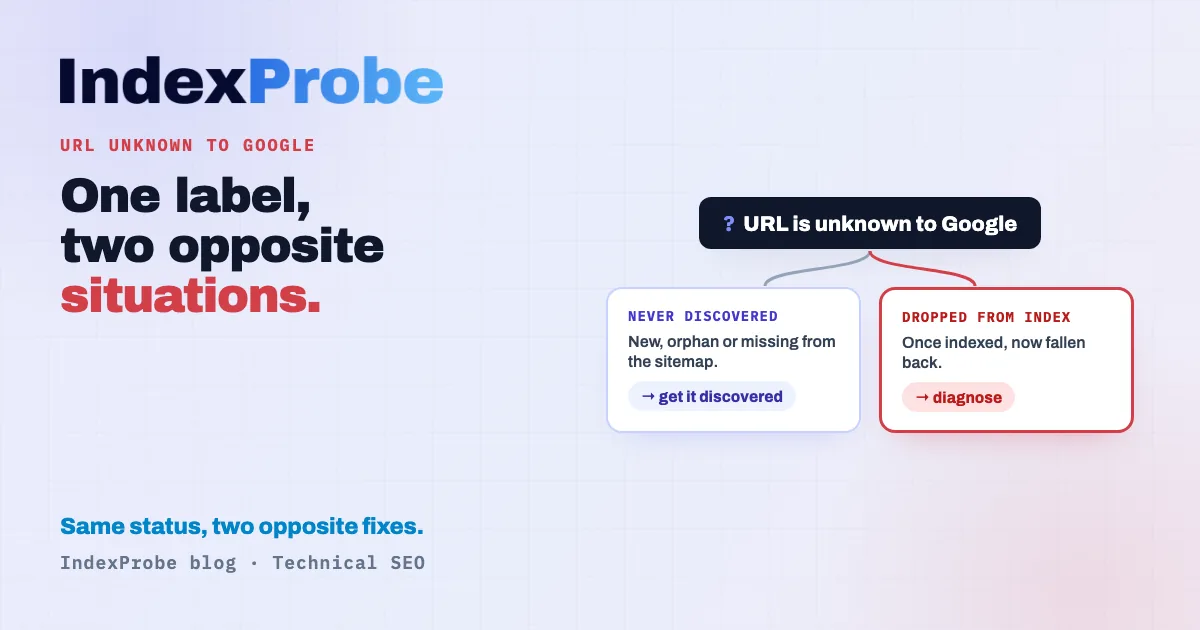
In Google Search Console's URL Inspection tool, "URL is unknown to Google" looks like a starting line. Sometimes it's a page that just dropped out of the index. Two opposite causes, two fixes.
The status means one plain thing: Google has never seen this address. No last-crawl date, no chosen canonical, no reason for non-indexing. Just a flat verdict. The instinct is to read it as a fresh page waiting to be found. But the same label sometimes lands on a page Google knew well, a page that was indexed and ranking, and that has just vanished from the index.
So the real question is which of the two you're looking at. Why does a page you requested indexing on stay "unknown" for days? And how do you spot, across hundreds of URLs, the ones that fell back into this status after a regression? It all turns on one thing: did Google ever know this address, yes or no.
"URL is unknown to Google": what Google is actually telling you
"URL is unknown to Google" means Google has never encountered this address: it isn't in its system, not in the crawl queue, not in the index. Google's own wording is blunt: this status "means that Google hasn't seen this URL before." It's a total absence of any record, not a verdict on the page.
Rule out right away what this status is not, because the confusion leads straight to the wrong fix:
- It isn't a quality judgment. Google hasn't read the page, so it has evaluated nothing. No point rewriting content no one has looked at.
- It isn't a
noindextag. A noindexed page is known to Google, which saw it and then deliberately excluded it. That's the Excluded by 'noindex' tag status, not this one. - It isn't a
robots.txtblock. A page blocked from crawling is also known to Google: it saw the URL but chose not to fetch it. That's Blocked by robots.txt. - It isn't a 404. A 404 means Google requested the URL and got a response. Here, it never requested anything at all.
The thread running through all four cases: in every one, Google knows the URL. "Unknown" is the only status where it holds no record at all. That's exactly what makes it ambiguous, because that absence of any record can mean two radically different things.
Two opposite situations behind the same label
The single verdict "URL is unknown to Google" covers two realities that call for opposite actions. Either the page was never discovered: it's brand-new, or nothing links to it, and Google simply hasn't found it yet. Or the page was known and indexed, then dropped out of the index, and falls back into this status as if it had never existed.
The first situation is a starting point. The page is new or isolated, and the job is to get it discovered: a link, a sitemap entry, a one-off submission. It's bootstrapping work, with no particular urgency.
The second is a regression, and it's the opposite of a starting point. A page that was ranking and pulling in traffic can end up out of the index once Google stops finding it useful. Once deindexed, its URL may well show "unknown to Google" again on inspection. Here the job isn't to bootstrap: it's to work out why an established page slipped, and to bring it back.
The trap is mistaking one for the other. Treating a regression like a simple starting point ("I'll add a link and request indexing") hides the real question: what pushed this page out of the index, and is it already hitting other pages of the same kind? The distinction comes down to one signal: did this URL already have traffic and rankings? If it did, you're looking at a regression, not a starting point. That same fork, starting point, regression or plain ranking problem, structures our full diagnostic for a website not showing up on Google, at the scale of the whole site.
What causes a "URL is unknown to Google"
The causes split into the two families we just laid out: the ones that keep a page from being discovered, and the ones that push a known page out of the index. Diagnosis always starts by working out which family you're in.
Never discovered
Google can only index what it finds. When nothing leads to a page, it stays out of sight.
- Orphan page, no internal links. No link on your site points to it. Internal links are the main path Googlebot uses to discover your pages; without them, a new page can stay invisible for a long time. Google itself notes that to learn about a page, it must find a link to it, or you must submit a sitemap or a crawl request.
- Missing from the sitemap. The sitemap is one of the channels Google uses to learn your URLs exist. A page that isn't in it, and that nothing links to, has almost no chance of being found.
- Never submitted. The page just went live and no signal has reached Google yet. It's the most ordinary case, and the easiest to fix.
- URL version mismatch. You're inspecting
https://example.com/pagewhile your site serveshttps://www.example.com/page, or the reverse, or anhttp://version instead ofhttps://. To Google, those are separate addresses. The version you type into the inspection tool may not be the one Google knows: it indexed the canonical (thewwwone, say) and reports "unknown" for the variant you're testing. The page is in the index, just under a different address. This is a common false alarm, the first thing to check when a page you know is live comes back "unknown." - Upstream block. A
robots.txtrule or a server response keeps Googlebot from reaching the area where the page lives, so no crawlable link leads to it. The block itself produces its own status (see Blocked by robots.txt and Indexed, though blocked by robots.txt), but its side effect is to cut off the discovery path for the pages sitting behind it.
Regression: dropped from the index
Here Google had the URL, indexed it, then removed it. Once the page's record is wiped, its URL can flip to "unknown," as if it had never been indexed. This is a field observation rather than a category Google documents, but it shows up often enough to name.
- Loss of clicks and impressions. The page had rankings, and they faded. When a page stops showing up in results, it's often a sign Google has dropped it from the index, or is in the process of doing so.
- Devalued content. The page has aged, its topic got covered better elsewhere, or a site cleanup left it thin. Google judges it less useful and eventually stops keeping it.
- Crawl thinning out. Googlebot spaces out its visits to a page it no longer values, then stops recrawling it altogether. With no confirmation, the page can slip out of the index. A page Google no longer crawls is a page on borrowed time.
These regression causes overlap with other statuses in the series: before flipping to "unknown," a fading page often passes through Crawled, currently not indexed. "Unknown" can be the next step, when Google has not only stopped indexing the page but wiped its record.
"I requested indexing and it's still unknown": should I worry?
No, not yet. After requesting indexing through the URL Inspection tool, it's normal for the status to stay "unknown" for a few days. Google's documentation puts it plainly: indexing typically takes only a day or so, but can take much longer in some cases. The request puts the URL in the queue; it doesn't drop it into the index overnight.
More to the point, this wait is neither a refusal nor a penalty. Requesting indexing flags a URL to Google; it doesn't compel inclusion. Google says as much without softening it: submitting a request does not guarantee the page will appear in the index. As long as the status stays "unknown" shortly after your request, you have no reason to conclude there's a quality problem. Google hasn't evaluated the page: it hasn't processed it yet.
When does it become abnormal? When the delay stretches well past any reasonable wait and a resubmission changes nothing. At that point, "unknown" stops being a simple wait: it points to an unresolved underlying cause. A page Google can't reach (orphan, missing from the sitemap) will stay "unknown" no matter how many requests you file. And resubmitting the same URL every day doesn't speed processing up: it isn't the volume of requests that decides, it's Google's ability to reach the page and then judge it worth keeping.
URL unknown vs Discovered vs Crawled: telling them apart
Three statuses describe a page that's "not in the index," but at three opposite stages of Google's journey. The distinction rests on two questions: does Google know the URL, and has it crawled it? "Unknown" answers no to both; Discovered, currently not indexed answers yes then no; Crawled, currently not indexed answers yes to both.
| GSC status | Does Google know the URL? | Has it crawled it? | Nature of the problem | Lever |
|---|---|---|---|---|
| URL is unknown to Google | No | No | Discovery (or drop from index) | Get it discovered: link, sitemap, submission — or diagnose the regression |
| Discovered, currently not indexed | Yes | No, not yet | Crawl priority | Give Google a reason to crawl: internal links, crawl budget, server |
| Crawled, currently not indexed | Yes | Yes | Indexing decision (often quality) | Improve the page itself |
The progression is logical: Google doesn't know the URL ("unknown"), then discovers it and holds it in the queue ("Discovered"), then crawls it without indexing it ("Crawled"). The classic trap is to graft the fix for one stage onto another. Rewriting the content of an "unknown" page does nothing, since Google hasn't even found it. Conversely, just adding a link to a "Crawled" page ignores the real problem, which is a page that was read and then set aside. Each stage has its own lever, and only that one.
Identifying the pages at scale
Now that both situations are laid out, the next step is knowing which of your URLs are affected, and which family each falls into. Search Console's URL Inspection tool gives the official verdict per address, but one URL at a time: you inspect, you read, you move to the next. On a few pages, that's workable. To tell apart, across hundreds of URLs, the pages never discovered from the ones that fell back into "unknown" after a regression, manual inspection no longer cuts it.
That's the wall IndexProbe breaks: the bulk version of Google's URL Inspection tool. It queries the official Search Console API to inspect, in a single analysis, the list of URLs you give it (CSV import, sitemap, paste) or the one you build from your own Search Console. For each page, it returns the official status Google holds on record and the date Googlebot last visited. IndexProbe doesn't crawl your site to discover URLs: it inspects the ones you give it, and only those.
The value here is in separating the two populations the "unknown" label wrongly lumps together. New or orphan pages never discovered call for bootstrapping work. Pages that fell back into "unknown" after dropping from the index call for a diagnosis. And IndexProbe knows how to isolate the second kind: they're the pages that had clicks and no longer have recent impressions. A page once ranking, now without a single appearance in results, betrays a likely drop from the index, exactly the silent regression that no case-by-case inspection surfaces.
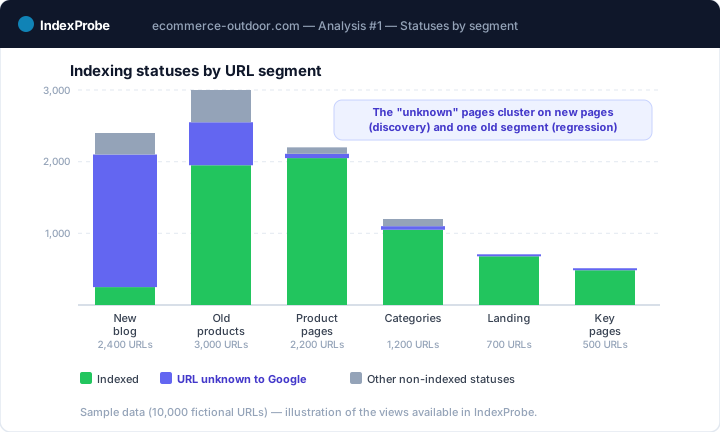
What you get out of the analysis depends on the list you bring in.
- A selection of strategic pages (your key pages, your sitemap of pages meant to be indexed). Any important page that comes back "unknown" is an immediate signal: if it had traffic, it's a regression to handle first; if it's new, it's a discovery to trigger. No extrapolation, the verdict lands on pages whose value you already know.
- A full export of your URLs (entire sitemap, crawl export). The breakdown by page type shows where the "unknowns" concentrate: a new segment still invisible (discovery) or an old segment slipping (regression). The concentration steers the decision per family rather than case by case.
💡 Want to separate your never-discovered pages from the ones that dropped after falling out of the index? IndexProbe inspects your URL list through the Search Console API and gives you the answer in one analysis. Try IndexProbe in early access →
Fixing it: two paths per the situation
Now that you know which URLs are affected and which family they fall into, the fix follows the situation. A page never discovered is fixed by discovery; a page dropped from the index is fixed by diagnosis. Applying one in place of the other wastes time and solves nothing.
Page never discovered: trigger the discovery
The goal is simple: give Google a path to the page, and a signal that it exists.
- Add the page to your sitemap. A URL listed in a clean, up-to-date sitemap is one of the most direct channels for making it known to Google.
- Link to it from your already-indexed pages. A contextual internal link, placed on a page Googlebot visits often, opens the discovery path. It's the most durable lever: it relies on no manual submission.
- Unify your URL versions. If the page exists in several variants (
www/non-www,http/https), pick one as canonical and 301-redirect the others to it. That keeps Google from knowing one version while you inspect another, reported as "unknown." Google settles on the version served overhttps, listed in the sitemap, and confirmed by therel="canonical"tag: make those three signals converge on the same address. - Lift any upstream block. If a
robots.txtrule cuts off access to the area where the page lives, remove it to restore a crawlable path. - Submit priority pages through URL Inspection. For a handful of pages, the inspection tool offers a Live Test (to confirm the page is reachable and crawlable) then "Request indexing." It's a one-off nudge, never a bulk strategy: across hundreds of URLs it doesn't hold up, and resubmitting on a loop achieves nothing.
Page dropped from the index: diagnose before resubmitting
Here, resubmitting first is a mistake. A page Google set aside for an underlying reason will return to the index, then drop out again, as long as the cause goes untreated.
- Diagnose the loss. Cross-reference the page's history: how long since it lost its clicks, its impressions, its rankings? Has Google's last-crawl date gone stale? Those are the signals that reveal whether the page slipped out of the index through devaluation or through a thinning crawl.
- Reinforce or consolidate the page. If the content was devalued, update it, flesh it out, or merge the page with a fuller one on the same topic (with a 301 redirect to the version you keep). The aim is to give Google a reason to keep it again.
- Only then resubmit. Once the cause is handled, request indexing to signal to Google that the page has changed. This time the resubmission rests on a real fix, not on the hope that another pass will be enough.
Confirming the URL is known again (and indexed)
Fixing isn't enough; you have to confirm Google took note. A URL that moves from "unknown" back to known still isn't at the end of the road: "known" only means Google now holds a record of the address, not that it has indexed it. The end goal is still indexing. In between, the page often passes through "Discovered" (known, in the crawl queue) then "Crawled" (crawled, awaiting a decision).
Re-inspect the URLs you handled after a few days, then track how they move over time. A single analysis proves nothing: it's the comparison between a before state and an after state that shows the movement, whether it's a new page finally discovered or a page that dropped out and was brought back.
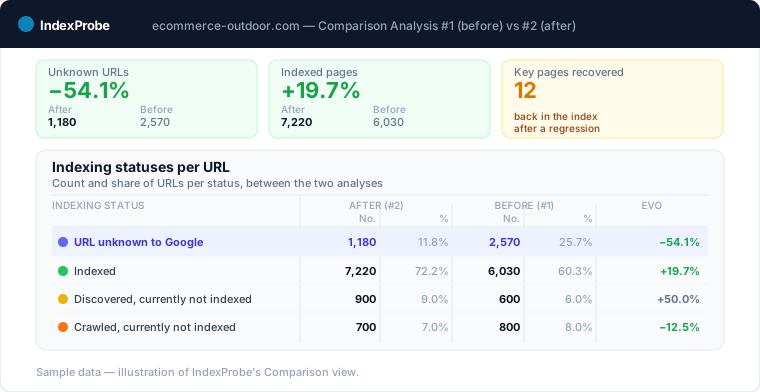
IndexProbe's COMPARISON view is built for this tracking: it sets two analyses side by side and quantifies, per URL, the moves from "unknown" to "Discovered," "Crawled," then "indexed." One point to watch: a page just discovered doesn't rejoin the index instantly. An "unknown" page that became "Discovered" isn't a failure, it's a stage cleared; the movement matters more than the frozen status of a single analysis.
At scale, this status mostly hits generated pages: entire templates Google never discovered, for lack of internal links or sitemaps. The programmatic SEO indexing page shows how to measure each template's real discovery rate.
Frequently asked questions
What does "URL is unknown to Google" mean in Search Console?
It means Google has never seen this address: no record in its system, not in the crawl queue, not in the index. It isn't a quality judgment, a noindex, a robots.txt block, or a 404. In all those other cases Google knows the URL; here, it holds no record at all.
Why is my page still "unknown" after I requested indexing? It's normal in the first few days: indexing typically takes a day or so, sometimes much longer. The request puts the URL in the queue; it doesn't index it instantly, and it doesn't guarantee indexing. It only becomes abnormal if the delay stretches on and an underlying cause (orphan page, missing from the sitemap) goes unresolved.
What's the difference between "unknown," "Discovered," and "Crawled"? For "unknown," Google doesn't know the URL and hasn't crawled it. For Discovered, currently not indexed, it knows the URL but hasn't crawled it yet (a crawl-priority problem). For Crawled, currently not indexed, it crawled the page and chose not to index it (often a quality matter). Three stages, three levers.
How long does Google take to index a new page? There's no guaranteed timeframe. Google says indexing typically takes a day or so after a request, sometimes much longer, and is never certain. The delay depends on how easily Google reaches the page (internal links, sitemap) and on the value it finds in it. Resubmitting daily speeds up nothing.
Is "URL is unknown to Google" a quality problem? No. Google hasn't read the page, so it has evaluated nothing. The status describes an absence of record, not a decision about the content. Rewriting an "unknown" page does nothing: until it's discovered, its content isn't in play.
Can an indexed page become "unknown" again? Yes, this is observed. When a page drops out of the index (devalued content, thinning crawl, lost rankings), its URL can show "unknown to Google" again on inspection, as if it had never existed. That's a regression, not a starting point: the right move is to diagnose the loss, not just add a link.
How do I check this status across a large number of URLs? Search Console's URL Inspection handles one URL at a time. To triage at scale, a tool like IndexProbe inspects the URL list you provide through the official API and returns, per URL, the official status and the date Googlebot last visited. Cross-referencing past clicks against recent impressions isolates the pages that fell back into "unknown" after dropping from the index.
Stop reading "URL is unknown to Google" as a simple starting point. IndexProbe plugs into the official Search Console API and inspects your URL list in a single analysis: official status per URL, the date Googlebot last visited, and a cross-reference of past clicks against recent impressions. You separate the never-discovered pages from the key pages that fell back into "unknown" after a regression, and you verify from one analysis to the next, with the COMPARISON view, that they turn known again then indexed.