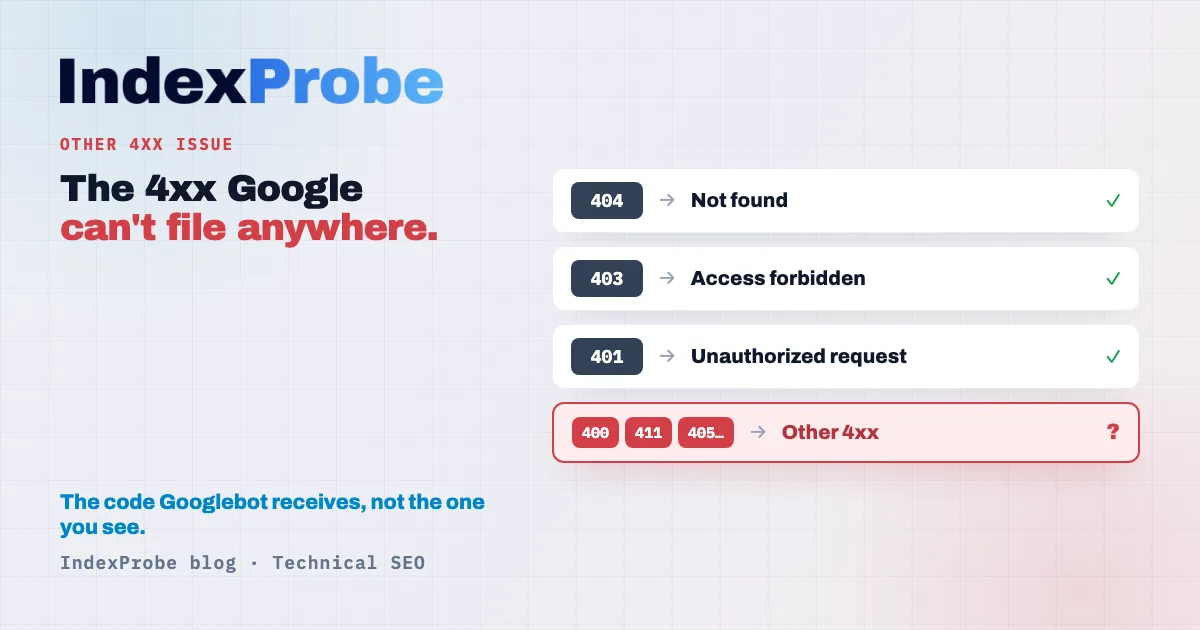
In Google Search Console's "Page indexing" report, every common 4xx error gets its own label: a 404 becomes "Not found", a 403 "access forbidden", a 401 its own. "Blocked due to other 4xx issue" gathers all the rest: the 4xx Google records but can't file anywhere else.
Where does this status come from, when none of the usual labels fit? Why does the affected page open normally in a browser while Googlebot runs into an error? And how do you find, among thousands of URLs, the ones that share this same silent 4xx?
Three questions whose answers all sit on Googlebot's side, never on yours.
"Blocked due to other 4xx issue": what Google means
According to the official documentation, this status means "the server encountered a 4xx error not covered by any other issue type described here." It is, quite literally, the drawer for orphan codes: every 4xx Google runs into but can't label anywhere else.
The effect on indexing is clear-cut. When Googlebot receives a 4xx, it treats the page as improperly served and won't index it. The page drops out of the index if it was there, or never enters it if it's new.
What makes this status tricky is precisely its anonymity: Google publishes no list of the codes that land here. The only codes explicitly filed elsewhere are documented. A 404 or a 410 becomes Not found (404), a 401 its own reason, a 403 access forbidden. Everything else falls into this drawer, with one exception: a 429 (too many requests) is treated as a server error (5xx), not as an ordinary 4xx.
Here vs elsewhere: which 4xx codes land here
The status groups the 4xx codes Google doesn't classify anywhere else. In practice, that's most often a 400 (bad request) or a 411 (length required), and sometimes 405, 406, 422 or 451 depending on server config. The most common codes, by contrast, each have a dedicated label in Search Console.
| Code Googlebot receives | Filed | GSC status |
|---|---|---|
| 400, 411 (and, depending on config, 405 / 406 / 422 / 451) | HERE | Blocked due to other 4xx issue |
| 404, 410 | elsewhere | Not found (404) |
| 401 | elsewhere | Blocked due to unauthorized request (401) |
| 403 | elsewhere | Blocked due to access forbidden (403) |
| 429 | elsewhere | Server error (5xx) |
Remember the principle rather than the list: if a 4xx has no dedicated label, it ends up here. Since Google doesn't document the exact make-up of this drawer, the useful instinct isn't to guess the code, but to go read the one Googlebot actually received.
The trap: the page opens in your browser, but Googlebot gets a 4xx
Here's what throws most SEOs off with this status: the page renders perfectly when you open it, and Search Console keeps flagging it as an error. The reflex is to call it a false positive. It's almost always a misreading.
The reason comes down to a simple asymmetry: what your browser sees isn't what Googlebot receives. You arrive from your own IP address, your user-agent, your session cookies, your usual headers. Googlebot arrives from Google's IP ranges, with its own user-agent, no cookie and no session. A rule that tells those two profiles apart can serve a 200 to one and a 4xx to the other, with nothing showing on your side.
So the only verdict that counts isn't what you see, but the code Google received. As long as you test from your own machine, you're measuring your own access, not Googlebot's.
Read the exact code Googlebot receives (live test)
To settle it, open Search Console's URL Inspection tool, then run "Test live URL". Google repeats the request in real time as Googlebot and shows you the HTTP code it actually gets back. That's the verdict of record, not what your browser displays.
A curl or a browser run from your machine can return a 200 while Googlebot gets a 4xx: the IP, the user-agent and the headers differ, and the blocking rule often keys on exactly those signals. Reproducing Googlebot's code from your own end is therefore rarely reliable.
One limit of the method remains: this test only covers one URL at a time. For a single page, that's enough. As soon as the status hits a batch of URLs, inspecting them by hand quickly becomes impractical, a point we come back to below.
Why Googlebot gets another 4xx: the causes
In the vast majority of cases, this 4xx comes from a layer between Googlebot and your application, not from the page's content. A security rule, a CDN or an anti-bot mechanism intercepts Googlebot's request and returns an error code that nothing exposes in an ordinary browser.
The first cause to check is the web application firewall (WAF), the CDN or the anti-bot solution. Many of these systems filter automated traffic and, rather than answering cleanly, serve an unusual 4xx to anything that looks like a bot, Googlebot included. A miscalibrated "challenge" rule, an overly broad DDoS protection or a user-agent blocklist is enough to trigger the problem.
Rate-limiting is a frequent and insidious trap. When your server decides Googlebot is querying it too often, it should respond with a 429. Some configurations return a generic 4xx instead: rather than signalling "slow down", they signal "access denied". Google files the 429 alongside server errors (5xx) and knows how to read it, but a poorly chosen 4xx throws it off and sends it into this drawer.
Then come more technical causes. An Accept header your server deems incompatible can produce a 406 (Not Acceptable). An HTTP method Googlebot uses that your server refuses can return a 405 (Method Not Allowed). A 411 appears if the server requires a Content-Length header the request doesn't carry. Finally, geographic or IP-range filtering can block Google's servers if they aren't explicitly allowed.
Now that you know the possible causes, you still need to know which of your URLs are affected.
At scale: isolating the URLs that share the same silent 4xx
This status has a particularity: it's rarely widespread, more often a scattered minority. A few pages caught by a WAF rule, a whole directory behind a misconfigured protection, URLs served by one specific CDN. Inspecting each URL one by one in Search Console to track them down simply isn't sustainable.
The goal is to group at a glance every page receiving the same crawl code, then spot a common thread (a URL prefix, a path segment, a URL pattern). That's what a read by crawl code, applied to your whole set of URLs rather than URL by URL, makes possible.
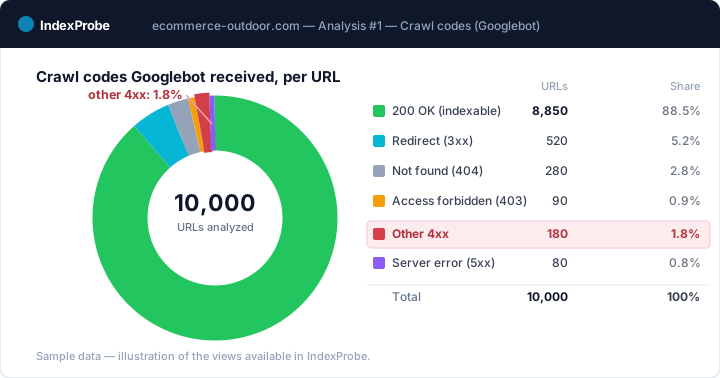
That's exactly what IndexProbe is built for. On a list of URLs you provide (sitemap, CSV, crawl export) or build from GSC, the tool queries the Search Console API and returns, for each page, the crawl code Googlebot actually received, dated to its last visit. You filter on the pages in "other 4xx", cross-reference them by segment, and the common thread jumps out. IndexProbe is not a crawler: it only analyzes the URLs you give it, never ones discovered by following links.
💡 Spotting these silent 4xx across a whole site, one URL at a time, isn't practical. IndexProbe inspects your URL list via the Search Console API and returns, per page, the code Googlebot actually received, dated to its last visit. Try IndexProbe in early access →
Fixing it: allow Googlebot properly
The fix almost always plays out on the layer serving the 4xx, never on the page's content. Start by locating the culprit: WAF, CDN, anti-bot solution or application rule. The live test gave you the exact code; that code points straight to the layer to inspect.
To allow Googlebot, the right method is reverse DNS verification, not the user-agent. A "Googlebot" user-agent can be spoofed in a single line: whitelisting on that string alone opens the door to fake bots. The reliable method is to run a reverse DNS lookup on the IP that shows up, confirm it resolves to a googlebot.com or google.com domain, then confirm with a forward DNS lookup that this domain points back to the original IP. You can also lean on the official IP ranges Google publishes.
For the rest, the fixes are mechanical. If rate-limiting returns a 4xx, reconfigure it to respond with a 429 plus a Retry-After header: Google understands that signal and slows down without deindexing. If a 406 stems from overly strict content negotiation, relax how the Accept header is handled. If a 411 blocks the crawl, check that the server doesn't demand a Content-Length on requests that don't carry one. Once the rule is corrected, run a fresh live test to confirm Googlebot now gets a 200.
Confirming the fix worked
A fix is never settled until Google has seen it. Two signals confirm it: a live test that returns 200, then the status flipping after a fresh Googlebot visit. That re-crawl isn't instant; expect anywhere from a few days to a few weeks depending on the page's crawl frequency.
The live test validates the present moment, but it's the comparison of two successive analyses that shows the real shift in the index. You watch the batch of URLs leave the "other 4xx" status and move back to indexed.
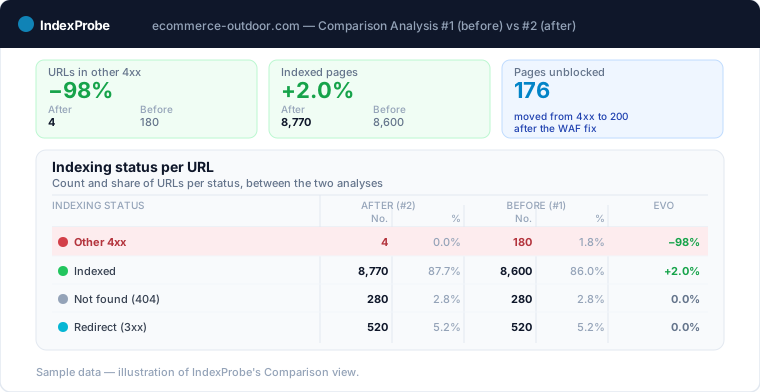
The same instinct applies to ongoing monitoring. A deploy, a new WAF rule or a CDN configuration change can reintroduce the problem overnight, with no visible alert. Re-running an analysis after each deployment turns a silent incident into a signal you can catch before the traffic is lost.
💡 An infra fix is only validated once Google has re-crawled it. IndexProbe gives you, per URL, the official crawl verdict dated to Googlebot's last visit, on the list you provide or build from GSC, and stays repeatable to track the shift analysis after analysis. Try IndexProbe in early access →
Don't confuse it: 404, 403, 401 and "other 4xx"
These four statuses share the same family of codes but call for opposite actions. The right move depends entirely on what Googlebot received, not on what you see.
| Code | Typical cause | Action | Related GSC status |
|---|---|---|---|
| 404 / 410 | Deleted page, wrong URL, broken link | Redirect if relevant, otherwise let it drop | Not found (404) |
| 403 | Access denied even though the request is valid | Lift the access ban for Googlebot | Access forbidden (403) |
| 401 | Authentication required | Remove the auth wall on public pages | Unauthorized request (401) |
| Other 4xx (400, 411…) | WAF / CDN / rate-limiting serving an unusual 4xx | Fix the infra rule, allow Googlebot via reverse DNS | Other 4xx issue |
One last trap deserves attention: a page that returns 200 but holds nothing useful can be classed as Soft 404, a case that has nothing to do with a real 4xx code. And if Googlebot gets a 5xx rather than a 4xx, the Server error (5xx) article is where to turn.
Frequently asked questions
What is "Blocked due to other 4xx issue"?
It's a status in Google Search Console's "Page indexing" report. According to the official documentation, it means "the server encountered a 4xx error not covered by any other issue type described here." It's the drawer for 4xx codes Google doesn't file under a dedicated label. The affected page is not indexed.
Which 4xx codes trigger this status?
Google publishes no official list of the codes in this drawer. In practice, you'll most often find a 400 (bad request) or a 411 (length required), sometimes 405, 406, 422 or 451. The common codes have their own status: 404 and 410 (Not found), 401, 403, and 429 (treated as a server error).
Why does my page open in the browser but Googlebot gets an error?
Because your browser and Googlebot don't arrive with the same profile: IP address, user-agent, cookies and headers all differ. A WAF, anti-bot or CDN rule can serve a 200 to your machine and a 4xx to Googlebot. Only the URL Inspection live test reveals the code Google actually received.
How do I fix a 4xx error in Search Console?
Locate the layer serving the 4xx (WAF, CDN, anti-bot, application), then allow Googlebot properly. Verify its identity via reverse DNS rather than the user-agent alone, which can be spoofed. If rate-limiting is the cause, respond with a 429 plus a Retry-After header. Then run a fresh live test to confirm a 200.
What's the difference between "access forbidden (403)" and "other 4xx"?
The 403 is a precise, documented code: the server understood the request but denies access, and Google gives it its own status. "Other 4xx" groups every other 4xx code with no dedicated label (400, 411, and so on). Put simply, a 403 is named and identified; the "other 4xx" drawer covers what Google can't file anywhere else.